
Video by Champ Williams of a sunflower star (Pycnopodia helianthoides) in vicious combat with a combined limpet-polychaete 1-2 punch! click and enjoy!
 Today, a little photoessay about some of my work with our ever-productive and efficient United States Antarctic Research Program (USARP) office!
 Tubs are opened to reveal....
 2. OMG! Its FILLED with Stars!!
  There are FOUR tubs full of starfish...somewhere approaching a thousand specimens! Many are rare and some are potentially new.
 3. Sorting, Rehousing & Identification! Next, there is sorting and the part where I make my special magic!! (and no..not the kind after I've had too much eggnog!)
 On each snappily re-housed specimen is a personally created identification tag! Where I leave my mark and the date I was working to ID that particular beast! (yes, I have identified starfish on holidays.)
 Note: Even though there's a lot here? These were actually from a PREVIOUS batch. Still several THOUSAND starfish to go!
 (Emily is a data entry commando!!)
 These specimens are NOW available to the research community for their uh..research community STUFF!!
We collected adults from sand beds of São Sebastião Channel (São Sebastião, SP, Brazil) and induced gamete release (eggs and sperm). We did the fertilization in vitro and followed the embryonic development in the laboratory, under light microscopy. Embryos become swimming larvae, approximately 0.2 mm wide, which we fed with microalgae until metamorphosis. A diminute sea biscuit grows inside the larva. When the minuscule podia and spines are formed the larva sinks and undergoes metamorphosis. The juvenile sea biscuit resorbs the larval tissue and begins to explore its new habitat, between sand grains.
We did the footage in the Marine Biology Center of University of São Paulo (CEBIMar-USP), located in São Sebastião, SP, Brazil, northern shore of State of São Paulo.
www.usp.br/cbm
You can find more information about this project in the website.
www.mestrado.organelas.com
and here in English..
Happy Weekend to Everyone!
 (bronze bust of NMNH Echinoderm Curator Austin H. Clark!) Austin H. Clark was the first curator of Echinodermata at the Smithsonian's newly developed National Museum of Natural History. He was considered in his day, by many, to be the world's undisputed expert on crinoids (feather stars and sea lillies) but wrote on all of the various echinoderms which came across his door at the Smithsonian.
 Perhaps one of the most remarkable echinoderm workers from the early 20th Century was Theodor Mortensen, who was a curator at the Zoological Museum at the University of Copenhagen in Denmark.
... the Report Of The Scientific Results of the Exploring Voyage of H.M.S. Challenger during the years 1873-76 which, among many other discoveries, catalogued 4,000 previously unknown species of animal. John Murray, who supervised the publication, described the report as "the greatest advance in the knowledge of our planet since the celebrated discoveries of the fifteenth and sixteenth centuries".They WEREN'T KIDDING. A good majority of starfish names were described from Challenger material. And a host of other echinoderm taxa are all covered in loving detail in the Reports of the Challenger expedition. Each is a HUGE oversized book...sometimes easily 6-8 inches thick!

 Probably one of my favorite professional monographs (and authors) is the Starfish Monographs written by Walter K. Fisher. W.K. Fisher was the Director of the Hopkins Marine Station, operated by Stanford University in Pacific Grove, California (now next to Monterey Bay Aquarium).
 Fisher, W.K. 1906. The starfishes of the Hawaiian islands. Bulletin of the United States Fish Commission. 23: 987-1130.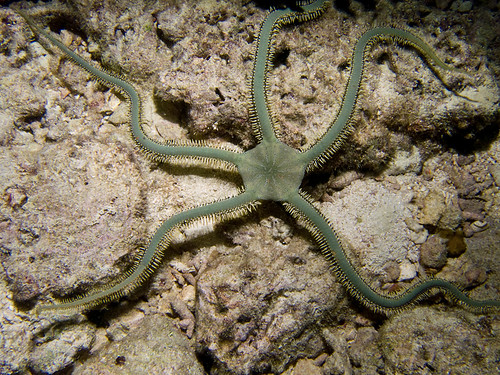
 This next part is pretty awesome.
  From here, it gets interesting.
 |
 (All images courtesy of Steve Stancyk, USC! Thanks!)
 (All images courtesy of Steve Stancyk, USC! Thanks!)Note the eye of the squid in the pic above. What the ophiuroids DO to the captured prey is brutal. They use their arm loops to literally REND the prey (squid, fish, etc.)...APART while it is alive.
 (All images courtesy of Steve Stancyk, UNC! Thanks!)
 And how motherfrakking big it is??
 These apparently have a similar posture...so MAYBE they also feed in this way????
 for a great many things. Many bloggers do.
 Pentagonaster pulchellus (Goniasteridae) taken by Miombori
 Pentagonaster pulchellus (Goniasteridae) taken by Chooks with the Looks
 Patiriella sp. (Asterinidae) taken by TimParkinson
 Stichaster australis (Asteriidae/Stichasterinae) taken by Sam&Onny
 Astrostole scabra (Asteriidae)-w/Coscinasterias muricata in the foreground. Taken by TelPortfolio
 Coscinasterias muricata (Asteriidae) taken by Ruth and Dave
 Henricia (Echinasteridae) taken by Ruth and Dave
 Diplodontias miliaris (Odontasteridae) taken by Hey Mambo
 and for the heck of it..I found this too!


