Tuesday, June 11, 2013

The Importance of Sea Cucumber Poop!

20111021-143924-Canon PowerShot G12-0720.jpg
Awesome pic by Mevallee
Let's just admit it. Poop is awesome. Its natural, all animals do it and its frakkin' hilarious. PLUS its biologically important to everyone so we can't just stop talking about it..

I have written about the importance of the poop of other echinoderms in prior posts-particularly this one about green sea urchins (Strongylocentrotus droebchiensis)

Recent research has brought a powerful spotlight on not just the ecological, but the overall, importance of sea cucumbers to the environment.  Sea cucumbers occur all over the world and at all depths. Often, when present, they are abundant or at least a significant part of the fauna present.

But the key dynamic present to their importance is that they cycle or process what they eat and what they defecate contributes to the health of the habitat they inhabit.

1. Sea Cucumber poop buffers against ocean acidification on coral reefs
2008-11-26 SAPONA WRECK - Sea cucumber poop
Image by scuba.linda
A paper by Kenneth Schneider (Stanford University) et al., including echinoderm researcher Maria Byrne's  was published in the Journal of Geophysical Research (2011. 116: G04032)  received a lot of press, such as this account (in Australian Geographic) and this one (which has an interview with Byrne) about how sea cucumber "poop" is important to geochemical processes on a coral reef.

I realize that articles about "coral reefs saved by sea cucumber poop" sound kind of silly on the surface, but read and understand below.... (note also the Journal of Geophysical Research? Important stuff gets put in there.)

Coral has to develop or accumulate calcium carbonate, which is the mineral used to compose coral skeletons, at an equal or better than the rate at which the coral loses calcium carbonate via erosion, natural dissolution, etc.

A survey of the sea cucumbers Stichopus herrmanni and Holothuria lecuospilota in One Tree Reef, Australia showed that the sea cucumbers could digest and dissolve so much of the adjoining sediment and rubble (ie the sand) that they actually contributed up to 50% or MORE of the total amount calcium carbonate dissolved over a night time. Presumably this was made available for coral to use for reef development.

Chemically, calcium carbonate is very alkaline or basic. So, sort of like an antacid. What do you do when you have stomach acids that are misbehaving? Drop some of those tablets to "cancel" out the acidity.

So, sea cucumbers contribute calcium carbonate to the coral reef's "chemical budget". They act like a natural antacid to neutralize other acidic environmental sources. Under normal conditions, there's an equilibirum. The abundance or number of sea cucumbers can affect this.

Thus, in theory,  MORE sea cucumbers might produce so MUCH alkalinity (or "basic" poop to the water) that conceivably they could function as a control or at least a buffer against increases in more acidic sea water.  This obviously is important when you consider ocean acidification resulting from global warming.  Sea cucumber poop is an important part of helping to keep the geochemical balance of a coral reef in equilibrium.

2. Sea Cucumbers EAT tasty bottom poop and clean it up!  
Poop is processed into useful nutrients! Over abundance of nutrients (i.e eutrophication) is broken up by sea cucumber feeding!

A recent paper in PLOS one from Thomas MacTavish and colleagues in New Zealand studied a local sea cucumber Australostichopus mollis and how its presence affects the nutrient cycling in its surroundings.

MacTavish and his colleagues studied a nutrient-rich environment covered by algae, mussel feces and other nutirent-rich goodies. Under normal circumstances, these would build up bacteria, ammonia and other factors creating conditions that contribute to the growth of  algae, which ultimately chokes everything else out (aka eutrophication).

But you put a sea cucumber into these settings? They LOVE it! They eat and all sorts of good things happen:
  • Bacterial abundance increases
  • Organic material (i.e., the goo) begins to decompose more quickly
  • Organic materials are redistributed from the marine sediments into the water
Sea cucumbers help to break down organic material and redistribute the nutrients! The poop is an important part of that process.

This has implications....

3. Eating good poop cleans up aquaculture environments
IMG_0694.jpg
Image by Jeremy and Christine
Papers such as the one above, this one focusing on the tropical Stichopus japonicus and this one on Parastichopus californicus in cold-temperate waters all show that many people have picked up on the fact that sea cucumbers are useful animals for breaking up environments that suffer from being choked in nutrients.

Eutrophication-the overabundance of nutrients resulting in undesirable growth of algae and hypoxia-is a common problem in aquacutlure ponds.
Sea Cucumber aquaculture
Image by Smartfish-ioc
But putting a sea cucumber into the mix? A critter that LOVES organic nutrients and gooey stuff like that?  It would go to town! Cleaning up the bottom and cycling those bottom nutrients...  Seems like a win-win solution for cleaning up the bottom of say a fish or mussel farm where feces from the animals accumulate in huge amounts.

So yes. Sometimes sea cucumbers eat poop. And then poop poop, which is probably "cleaner" than what went in the first place...

4. Sea Cucumber poop is good for plants (mangroves, seagrass, etc.), which are part of a healthy ecosystem
P7140072.JPG
Image by Eunice Khoo- "Mermate"
So, by this I don't just mean ONLY the poop-but the animal digesting and then processing the sediment.  This follows everything from the above-they break down organic detritus and make the nutrients available to the water column preventing hypoxia and other bad things going down in the sediment...
(its a great video, but I didn't enter the description!)

The nutrient cycling role of sea cucumbers has been observed as an important part of ecology. One post I put up awhile back shows that the presence of sea cucumbers leads to more productive sea grass!  and thus a more diverse and healthy tropical ecosystem.

Think of them as earthworms! go through the bottom sediments, eat all the organics and leave the sediment.. that's sea cucumber poop!

5. Deep-Sea Cukes have pretty diverse microbial faunas that live in their guts! (and thus their poop!)

Deep-sea sea cucumbers perform very much the same kind of function as the shallow water ones. They live in much finer mud and are often rained upon by nutrients from the surface. Many of these critters, such as Molpadia (shown here) live buried in the mud.

Most of their overall morphology seems devoted to processing mud..in one end and out the other...
We add to that another spin!  There are whole microbial faunas that live INSIDE their guts! Go to these past posts to read more about them..

Remember just how abundant these can be in the deep sea. Some occur at a density of 220 individuals per square meter!

How much of this fauna comes out in their poop?  How does it contribute to the local environment?

Tuesday, June 4, 2013

FIRE Urchins! Brilliant Shallow water cousins of the "tam o shanter"/pancake urchins!

Fire Urchin
Image by Aboireoujtulchien
Last week I reviewed deep-sea echinothurioid urchins aka the "tam o shanter urchin" aka the "pancake" urchin, etc., etc.  I spoke of these more generally in an earlier post. But for some reason I've not had a chance to really showcase their shallow water relatives!
From SERPENT
Shallow water echinothurioid urchins are "proper" fire urchins. As opposed to these other "fire colored" spiny urchins, such as Astropyga which are diadematoid urchins. A completely different group!!

"Spiny" urchins are distinguished by the presence of an Anal Cone. See that white bulb on top? THAT is where the poop comes out!  You don't see that in "proper" fire urchins as we'll be seeing.. Note also that the spines are much longer.
Astropyga radiata
(image by Ben Naden)
I've discussed Astropyga on the blog before (here)...

These urchins all belong to the genus Asthenosoma which includes six species spread throughout the Indo-Pacific region.  Here's a neat video that gives you an idea of what they look like..


Yes, the colors are a huge shift in appearance, but similar to their deep-sea cousins, Asthenosoma also has the distinctive "walking" spines...

On this image of Asthenosoma varium the walking spines form a fringe around the lower oral side composed of distinctly yellow spines. My understanding is that most of these prefer soft, muddy bottoms.
Asthenosoma varium
Image by Ben Naden
Compare to the walking spines on this deep-sea echinothurioid.
Spiny sea urchin
Image by NEPTUNE Canada
From there we start to see more differences as the spines seem to be bunched up in bundles...
But they remain venomous...
fire sea urchin
Image by JianXu
Some workers have hypothesized that the poisonous spines in deep-water echinothuroids function as hypodermic needles (here by Roland Emson & Craig Young)

And if its not clear by now, YES. They're pretty damn venomous. My understanding is that its very painful.. but typically not lethal.

and they certainly do seem like they do, don't they??
fire urchin IMG_6889
Image by Bruce Magun
Fire urchin's spines
Image by Daniel Stassen

Close ups! showing some of the brillaint colors, spine patterns and etc.. I suspect most of these are Asthenosoma varium
Fire urchin!
Image by MerMate
FireU2
Image by Daphna130
Fire urchin
Image by lupopeye
Magnificant Fire Urchin
Image by maractwin
fire urchin
Image by Nick Hobgood
fire urchin
Image by B. Maither
Fire Urchin Close-Up
Image by Russell Taylor
Here's some differing species from around the Indo-Pacific

From the Red Sea, Asthenosoma marisrubi with a more mellow look...
Foto-2008-05-08 21.31.25
Image by Key of Life
Here are the spines..still basically the same but different color and slightly different shape..
Asthenosoma marisrubri
Image by Le Congre
Asthenosoma spp. showing many different colors...
Coleman Shrimp and fire urchin
Image by S1mon Mar5h
IMG_0610
Image by Clark Chang
IBAb-292 Fire urchin, Asthenosoma varium
Image by Jesse Claggett
Fire urchin
Image by Richard Barnett
What's even MORE interesting? These urchins have tiny critters which live as commensals(?) among the highly poisonous spines! (this neat vid also shows a LOT of close up details)
Urchin Riders from liquidguru on Vimeo.
Some of the little buggers actually "hollow" out a space, clearing out spines where they can live! You can see the bare patch on this one...
Coleman shrimp
Tiny Shrimp
Image by Klaus Stiefel
In addition to all the various crustaceans, Amazingly. Here is a benthic ctenophore (which I've written about here) ON A FIRE URCHIN!! (the white blobby bits are the feeding tentacles)  Mind. blown!!  and incidentally.. a likely first occurrence recorded....
Ctenophore on a Fire Urchin
Image by Mark Atwell

Tuesday, May 28, 2013

New "Tam O Shanter" urchins (aka the Echinothurioids!) from Deep-Sea New Zealand!

Araesoma thetidis
In February of this year, my friends at the New Zealand Institute of Water and Atmosphere (namely Owen Anderson) published a new paper describing not one but SEVEN new species of deep-sea sea urchins! Here in the journal Zootaxa.

The original NIWA press release is here.  These urchins have been getting all sorts of keen press, including here in the N.Z. Herald and here in The Sun.  And of here on New Zealand's Maori news..


and I thought.. EVERYONE needs to know more about these exciting urchins! and so today is a bit of a "refresher" on echinothurioid sea urchins!

I wrote a short summary about these for Deep Sea News several years ago...(here)  and wrote a short bit about the commensal relationships between these urchins and fish here.

The quick summary version is:
  1. Mostly deep-sea urchins found all over the world (many in greater than 1500 m depths-in NZ they range from 100 to 5000 m!), but with some shallow water relatives (aka the Fire urchins, I'll save these for another day)
  2. They often have very sharp and poisonous spines. And yes, the deep-sea ones too...
  3. They "walk" around on the sea bottom with special spines that have hoof like tips
  4. They were described FIRST as fossils and the living animals were found AFTER...
When the animals are alive they look kind of like this:
Deep Sea Urchin - Submarine Ride 2540 Feet
An Atlantic species by Hankplank
On this purple species from the Pacific (Tromikosoma maybe? this isn't one of the new ones described by Anderson), you can see the white hoof-like spine tips that the urchins use to "walk" along the bottom..
Spiny sea urchin
Image by Neptune Canada
Here is a pic showing the oral surface (ie the bottom). The mouth is at center and as you can see it is surrounded by spines with those white "hoof" like tips. These are what the animals use to "walk" along the bottom of the sea floor.
Sea Urchin underbelly
Also by Neptune Canada

Here's the spine close up showing the "walking tip"
Image from the NIWA Benthic Inverts Facebook page
Or sometimes like this Atlantic Phormosoma placenta which has the mysterious floating "bags" (containing spines).
Image from SERPENT project here


But sadly, when they are brought up on the deck of the ship, the water rapidly drains from their very soft body and they are often left as a shadow of their former self....
From the NIWA page on this story
As a result of this "deflated" appearance, they are often called a variety of names: "pancake urchin", "leather urchin", "bag urchin", or "beret urchin." However in Anderson's new paper he feels a new common sobriquet would be most accurate-the Tam O Shanter urchin!!!

For those who are not as keen on Scottish headwear, a "Tam o Shanter" is a cap, sort of like a beret (wikipedia here)  and you can sort of see the resemblance.
Tam O' Shanter
Image by DrHaggis
dsc_0055 (2)
Image by H2omom.2006
Even alive, looking down on one, you can sort of see the resemblance..(note however this is not one of Anderson's new species)
Sea Urchin and Brittle Stars
Image by Neptune Canada!
Owen's paper (here) describes a whopping SEVEN species in two genera. That's pretty significant given that MOST of these urchins were described in the early part of the 20th Century/late 19th.

These were all discovered and described by looking at a variety of different characteristics. Some as straightforward as body color as well as spine shape and location. But some characteristics are more subtle. These are the individual pieces of pedicellariae-little claw like structures that are present on all sea urchins..which were studied using a Scanning Electron Microscope to yield distinct shapes...
Fig. 28 from Anderson 2013
He also reviewed the many echinothurioid urchins in the New Zealand waters, in addition to the seven known species, Anderson described/reviewed a further nine species (7 were new) culminating in a count of some 16 species of these urchins in the region!, including this beauty... Araeosoma thetidis!! (described by Hubert Lyman Clark in 1909)
Figure 28 from Anderson 2013
What other species will be found?  Here's a brand new report about two new sea pens! 

Tuesday, May 21, 2013

Starfish Macro Shots! Up Close Tropical Edition!

Sea Star -  Bunaken - North Sulawesi - Indonesia 06-01-2008 4-22-03 PM 4000x3000
This fantastic image by Tyson Jerry from North Sulawesi
By now, a bunch of people have seen the incredible collection of close-up asteroid photos by Alexander Semenov and I reviewed them for the Smithsonian here.

Those pictures were close ups of asteroids from cold-water settings in the North Pacific & North Atlantic. There's a very different fauna of asteroids in those parts of the world compared to the tropics.

Most of the starfish in the tropical Indian and Pacific Oceans show a lot of granules, spination and armor and of course are composed of very different families of asteroids compared to those which live in the far North.

If you'd like to see some pics of the mouth armor in these types of starfish go here!

I start with the above : a STUNNING shot of Protoreaster nodosus, a commonly encountered sea star found throughout the Pacific.  Shots below are macro shots showing skeletal features and colors of different tropical, Indo-Pacific starfish species.

More close up on Protoreaster with more pointed spines. Image by Nick Robertson Brown (Frogfish Photos)
seastar

What are these weird threads? Feeding tentacles from a benthic ctenophore? Gametes?  Weird. Photo by MerMate (Eunice Khoo)
Fuming star

The strange soft-warty structures are a distinguishing feature on the surface of Echinaster callosus! Function unknown. Images by Optical Allusion
Warty seastar (Echinaster callosus)

Warty seastar (Echinaster callosus)

Warty seastar (Echinaster callosus)

Some fantastic detail on the ophidiasterid Nardoa. Image by Stephane Bailliez
Warty sea star

Here's a close up on Gomophia gomophia. Image by Okinawa Nature Photography (Shawn Miller)
Starfish, Gomophia gomophia


An awesome close up of the disk on Fromia nodosa from the Maldives. Image by Philippe Guillaume.
M0023682


Close up of Fromia indica. Image by Jesse Claggett
starfish02-fromia-starfish_18221_600x450

The papulae (aka the gills) and spines of Acanthaster planci-the Crown of Thorns starfish. Image by Barry Fackler.
macro echinodermata


This one shows a close up of the gills of Acanthaster planci. Image by David Garcia Fonseca.
Estrella de Mar Corona de Espinas // Crown of Thorns Starfishh...MACRO!

Wow! First record of the brittle star Ophiactis? living on the spines of Pentaceraster. Image by Maractwin
Starfish detail

another tight shot of a brittle star (Ophiothela?) living on the asteroid Nardoa. Image by deco4macro
The same kind of star sans ophiuroid. Image by samui13coconut13

Surface spines on Pentaceraster. The tiny white circles on the brown spaces are papulae aka the gills. Image by Friscodive.
Sea star abstract 13]
Surface close up on the cushion star Culcita novaeguineae from the Maldives. Image by Frédérique Jaffeux. All the white pores are papulae aka the gills.
Cushion Sea Star
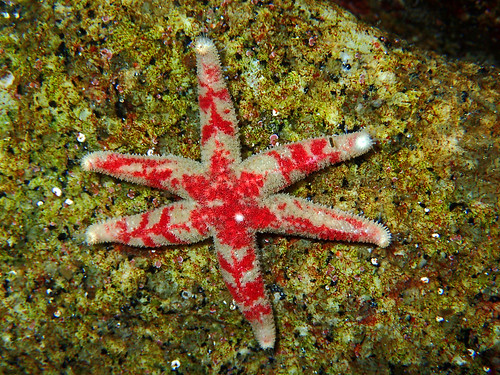
From the Sand star Luidia maculata Image by Kok Sheng
Eight-armed sea star (Luidia maculata)
And another L. maculata by [WJ]
IMG_7582s